Vision → Law → Execution → Openness → Growth → Global Influence
Six links. One chain. No shortcut between them.
The book does not assert this formula — it builds it from official data, institutional record, and documented outcome. Each link below is a chapter of the argument. Remove any one link and the chain weakens.
Vision
Direction held in decades, not electoral cycles.
The UAE’s national strategies — UAE Vision 2021, Preparing for the Next 50, We the UAE 2031, and Centennial 2071 — are not wish-lists. They are the output of a governance architecture designed to carry institutional targets across leadership tenures. Leadership in this book is examined not as charisma, but as architecture: the deliberate shaping of a national direction meant to outlast the people who set it.
In the book: Part I & Part IVLaw
Vision made trustworthy — the precondition for all commitment.
Law is the mechanism that converts vision into something strangers can trust. It establishes an order that capital, talent, and families can commit their futures to. The book examines the UAE’s legal architecture not as a list of statutes but as the answer to a governance problem: how do you persuade people with no cultural or historical connection to a place to build their lives inside it?
In the book: Part IIExecution
Law turned into institutions that actually function.
The book examines federal design as a management system: how shared national direction and local emirate execution were balanced so that seven distinct members could specialise without fragmenting. Government is examined as a performance machine — measured against targets, ranked against the world, organised around a chain of national strategies that reach from one decade into the next.
In the book: Part IIOpenness
Capital and talent invited — and structured to stay.
The UAE’s position as one of the world’s most open economies is a sustained policy choice, not a cultural tendency. The book examines openness as a strategic input: the deliberate decision to invite capital and talent that the system needed in order to grow, and the institutional design that made staying more attractive than leaving.
In the book: Part IIIGrowth
Sustained, compounded, and diversified beyond oil.
Growth is the output of the first four mechanisms. The book examines the diversification of the UAE economy — the shift from oil-dependence to a non-oil GDP majority — not as a point of pride but as a measurable result of the governance engine operating as designed. Non-oil real GDP share: 77.5% (FCSC, H1 2025).
In the book: Part IIIGlobal Influence
Growth, held long enough, becomes position.
The UAE’s standing in global finance, aviation, logistics, trade, and talent is the long-term consequence of the five mechanisms that precede it. This is the closing claim of the book: the UAE’s global position is not a branding achievement. It is a governance achievement.
In the book: Part VWhere the Chain Appears in the Book
The six links are not confined to single chapters — each one threads through the argument. This is a guide to where each mechanism is most directly examined.
The decisive thing the United Arab Emirates did with its oil was to refuse to let the oil become the country.— Chapter Three · Tomorrow Became a Country
Vision → Law → Execution → Openness → Growth → Global Influence
غَدٌ صَارَ وَطَنًا
Six links. One chain. No shortcut between them.
Book Details
Tomorrow Became a Country — غَدٌ صَارَ وَطَنًا
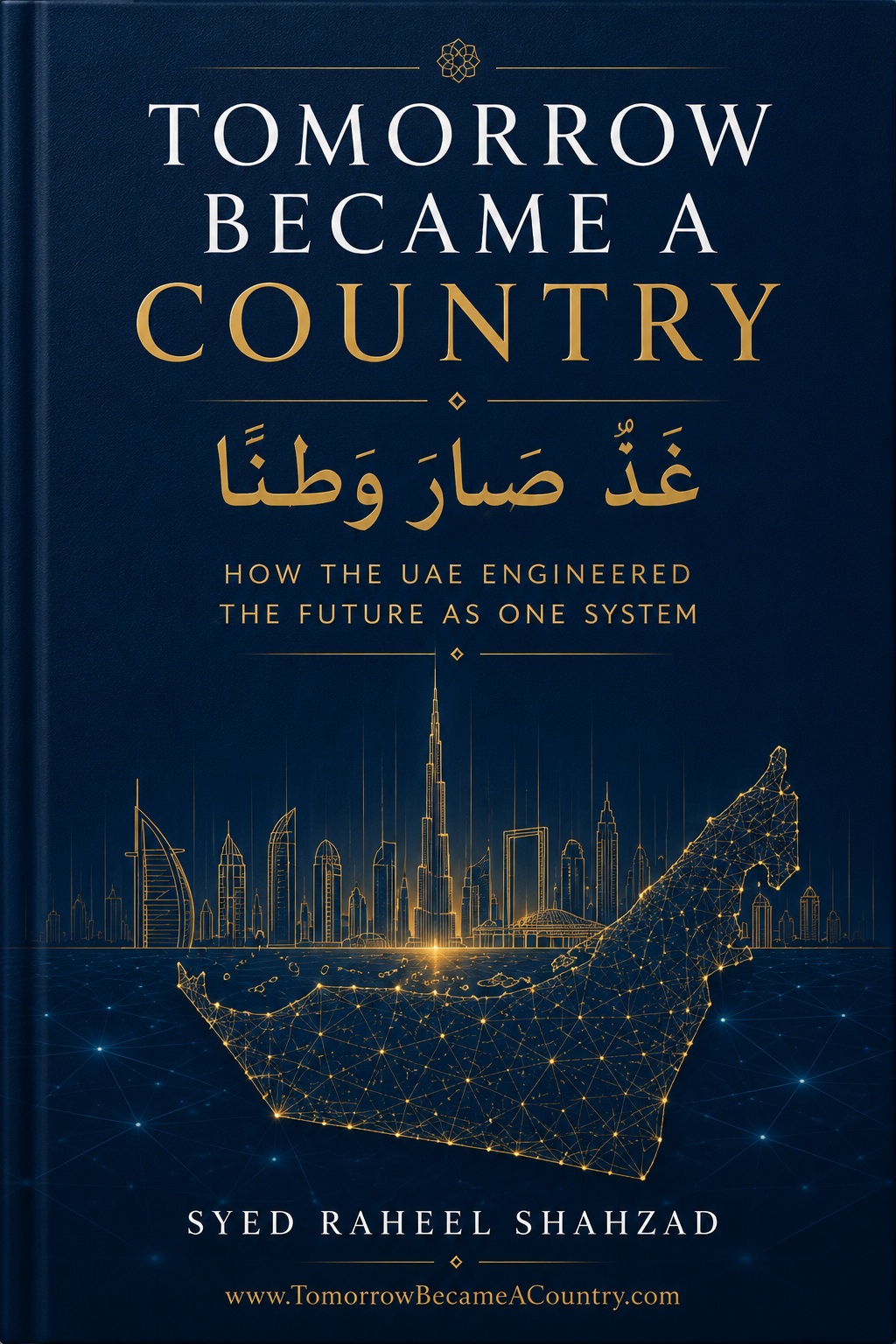
| Author | Syed Raheel Shahzad · سيد راحيل شهزاد |
|---|---|
| ISBN (Paperback) | 978-9948-61-299-5 |
| ISBN (E-Book) | 978-9948-61-619-1 |
| Publisher | The Syed Group |