The Method Behind Tomorrow Became a Country — How Syed Raheel Shahzad Writes
The Method Behind Tomorrow Became a Country — How Syed Raheel Shahzad WritesThe Method Behind Tomorrow Became a Country
How Syed Raheel Shahzad writes — the discipline that produced this book and 24 others before it.

Readers of Tomorrow Became a Country notice something before they notice the argument: the restraint. No superlative arrives without a source. No claim outruns the data behind it. That restraint is not a stylistic choice made for one book about one country. It is the same method Syed Raheel Shahzad has applied across twenty-five published works, on subjects as different as national governance and human identity.
Evidence Before Praise
The starting discipline is simple to state and difficult to hold to: praise travels only as far as the evidence cited alongside it. Before a claim about the UAE’s growth, its governance, or its institutions appears in the book, it is checked against official data — the Federal Competitiveness and Statistics Centre, national strategy documents, international benchmarks with their methodology stated. If the evidence does not support the claim, the claim does not appear. This is the same standard applied, years earlier, to claims about revelation, identity, and moral responsibility in his philosophical corpus.
Three Registers, Never Merged
What is documented, sourced, and dated — stated with its origin attached, never presented as self-evident.
What the data suggests about mechanism and design — labelled as interpretation, not disguised as fact.
Direct experience — as a UAE resident since 2010, as a reader of primary religious texts — placed after the evidence, honest about its limits.
This three-register discipline is what separates a proof-book from a praise-book, and from an opinion piece. It is why Tomorrow Became a Country reads the way it does, and it is the identical structure underneath The Source of Truth System™, The Architect’s Protocol, and The Qur’anic Coherence System.
“The decisive thing the United Arab Emirates did with its oil was to refuse to let the oil become the country.” — the method applied to a nation, exactly as it was applied, years earlier, to a person’s identity.
Primary Sources Over Secondary Opinion
Across the corpus, the instinct is the same: go to the primary source before consulting what others have said about it. In the philosophical and religious works, that means the Qur’an and authenticated hadith consulted directly, with no contemporary scholar cited by name and no sectarian position adopted. In Tomorrow Became a Country, it means official UAE government data and international benchmark methodology consulted directly, rather than summarised through commentary. The subject changed. The instinct to verify before repeating did not.
Why This Matters for Readers
Knowing the method changes how the book should be read. A reader who expects a tourism narrative or a celebration will find the tone unusually restrained. A reader who understands that this restraint is the author’s standing discipline — applied consistently across twenty-five works, not adopted for one — will recognise it instead as the book’s actual argument: that credibility is built the same way a governance system is built, one sourced claim at a time.

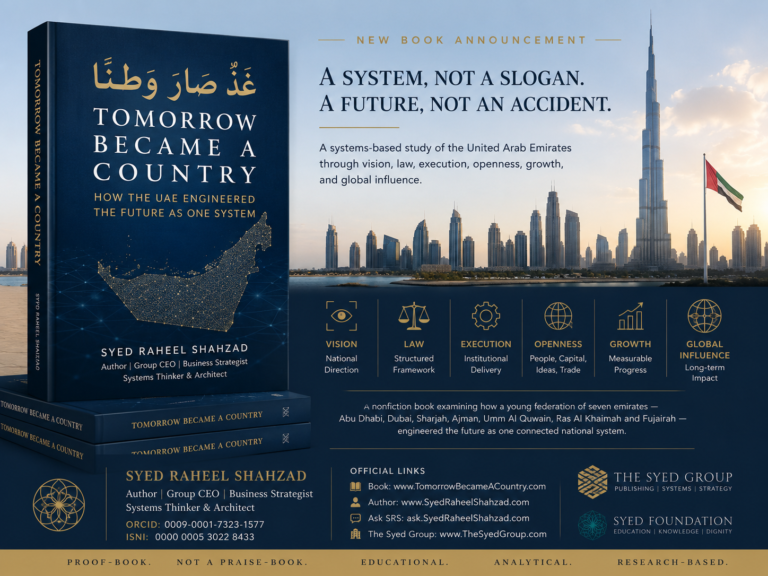
Tomorrow Became a Country
Now available worldwide in print and e-book, built on the same evidence-first standard.