Frequently Asked Questions: Tomorrow Became a Country
Frequently Asked Questions
Direct answers about Tomorrow Became a Country — what it is, what it is not, and the standard it holds itself to.
Readers ask the same handful of questions about Tomorrow Became a Country more than any others. This page answers them directly — no evasive framing, no marketing language.
What is Tomorrow Became a Country actually about?
It is a nonfiction systems study of the United Arab Emirates — how the federation moved from its 1971 founding conditions to its current position, examined through six linked mechanisms: Vision, Law, Execution, Openness, Growth, and Global Influence. It is not a history book in the narrative sense, and it is not a celebration. It is an argument about mechanism, built on official data.
Is this book an official publication of the UAE government?
No. Tomorrow Became a Country is an independent, author-written nonfiction study. It received a Publishing Printing & Text Permit from the UAE National Media Authority — a regulatory clearance that allows the book to be legally printed and distributed in the UAE — but that permit is not an endorsement of the book’s contents, arguments, or conclusions. The book does not claim to represent the official position of the UAE government, its rulers, or any of its institutions.
What is the “proof-book, not a praise-book” idea about?
It is the discipline the book holds itself to. Every statistic states its source, its year, and the basis on which it was computed. Data, interpretation, and the author’s personal witness are kept in three separate registers throughout — never merged silently. Praise in the book travels only as far as the evidence cited alongside it. No superlative appears without a source behind it.
Who is the book written for?
Four groups in particular: governance and policy readers studying how national vision becomes institutional reality; business leaders and strategists interested in the UAE as an operating system; academics and researchers in Gulf studies, development economics, or institutional design; and serious general readers who want the mechanism behind the country, not a tourism narrative.
What sources does the book rely on?
Official UAE data — the Federal Competitiveness and Statistics Centre, the UAE Central Bank, national strategy documents such as We the UAE 2031 and Centennial 2071 — alongside international benchmarks like the IMD World Competitiveness Yearbook and the Chandler Good Government Index, each cited with its own methodology stated rather than treated as a single combined score.
Where does the author’s own experience come into the book?
Syed Raheel Shahzad has lived and worked in the UAE since 2010 as a Group CEO. That direct experience is offered as testimony — labelled clearly as a separate register from the data, placed after the evidence in every chapter, and honest about the limits of one person’s vantage point. It is not used as a substitute for evidence.
What editions and formats are available?
The book is registered for paperback, hardcover, e-book, and audiobook editions, with ISBN registration confirmed under The Syed Group. Full ISBN details are recorded in the book’s Publication Record.
How is the book structured?
Five parts, twenty-one chapters, 422 pages. Part I establishes the founding conditions. Part II examines the governance engine. Part III covers the growth model. Part IV looks at long-range national strategy. Part V closes with what the demonstration proves — and what it does not. A dedicated System page maps every part in full.
The Wider Body of Work
This page sits inside a published catalogue of 25 titles across four connected bodies of work, plus Tomorrow Became a Country. The method is consistent across all of them: years of observation, primary-source research, and structured architecture applied to questions most writing leaves loose — how belief becomes behaviour, how vision becomes execution, how a system either produces what it was designed to produce, or fails to.
The Source of Truth System™ — 14 Volumes
A multi-volume architecture engineered through systems analysis rather than a single compiled work. It reads the classical Islamic tradition through a systems lens — asking not “what is the ruling” but what mechanism produces the gap between what a person knows and how they actually live. The fourteen volumes move through four phases:
| Phase 1 Stages 0–1.5 | Establishing Reality — The Reality of Existence (“Why Anything Exists at All”), The Book (“Why Revelation Is Necessary”), ONE (“From Oneness to Deviation”), Other Gods (“The Forensic Audit of Modern Shirk”). |
|---|---|
| Phase 2 Stages 2–4 | The Human Condition — Qadar (“The Ink Has Dried”), The Reality of Life (“From Dunya to Akhirah”), I, Undefined (“Beyond Labels, Toward the True Self”). |
| Phase 3 Stages 5–7 | Mastering the Self — The Inner System (“Nafs, Shaytan, and Tazkiyah”), Shajarah Tayyibah vs Shajarah Khabithah (“The Pure Tree and the Corrupt Tree”), Haqooq (“The Rights of Allah and the Rights of People”). |
| Phase 4 Stages 8–11 | The Prophetic Blueprint — Ibrahim (“The Architecture of Surrender”), Musa (“Revelation, Law, and Liberation”), Isa (“Mercy, Truth, and the Distortion of Love”), Muhammad ﷺ (“The Life That Changed Everything”). |
The Architect’s Protocol — 5 Books
A civilisational audit applying the same method to truth, power, moral order, design, and the machine-age challenge to human identity: God Is Back (“The Resurrection of Reason in a Post-Truth World”), The Jungle Protocol (“Dismantling Might Is Right and the Global Power Mafia”), The Moral Anchor (“Objective Right and Wrong in an Age of Relativism”), Authored (“Signature and Source”), and The Last U-Turn (“AI, Transhumanism, and the Choice to Remain Human”).
The Qur’anic Coherence System — 4 Volumes
A scholarly mapping of Qur’anic architecture and naẓm — the structural evidence of the text’s internal design: The Qur’anic Coherence Framework (“The Logic of Revelation, Order, and Guidance”), The Macro-Architecture of the Qur’an (“The Seven-Group Structure and the Movement of Revelation”), The Surah Map of the Qur’an (“A 114-Surah Structural Atlas”), and The Forensic Atlas of the Qur’an (“Evidence, Patterns, and Structural Verification”).
Adam and the Answerable Being — Standalone
A standalone scholarly argument on Islam, human origins, and Qur’anic anthropology: “Islam, Evolution, and the Constitution of Moral Humanity.” Its opening line states its position directly — “Before the body was modern, the human became responsible.”
Every volume across all four bodies of work is grounded exclusively in primary sources — Qur’an, authenticated hadith, and classical Islamic scholarship — with no contemporary scholar cited by name and no sectarian position adopted. The same discipline that produced these 25 titles produced Tomorrow Became a Country: evidence before praise, primary source before secondary opinion, structure before decoration.
View the complete catalogue on the author’s official platform →

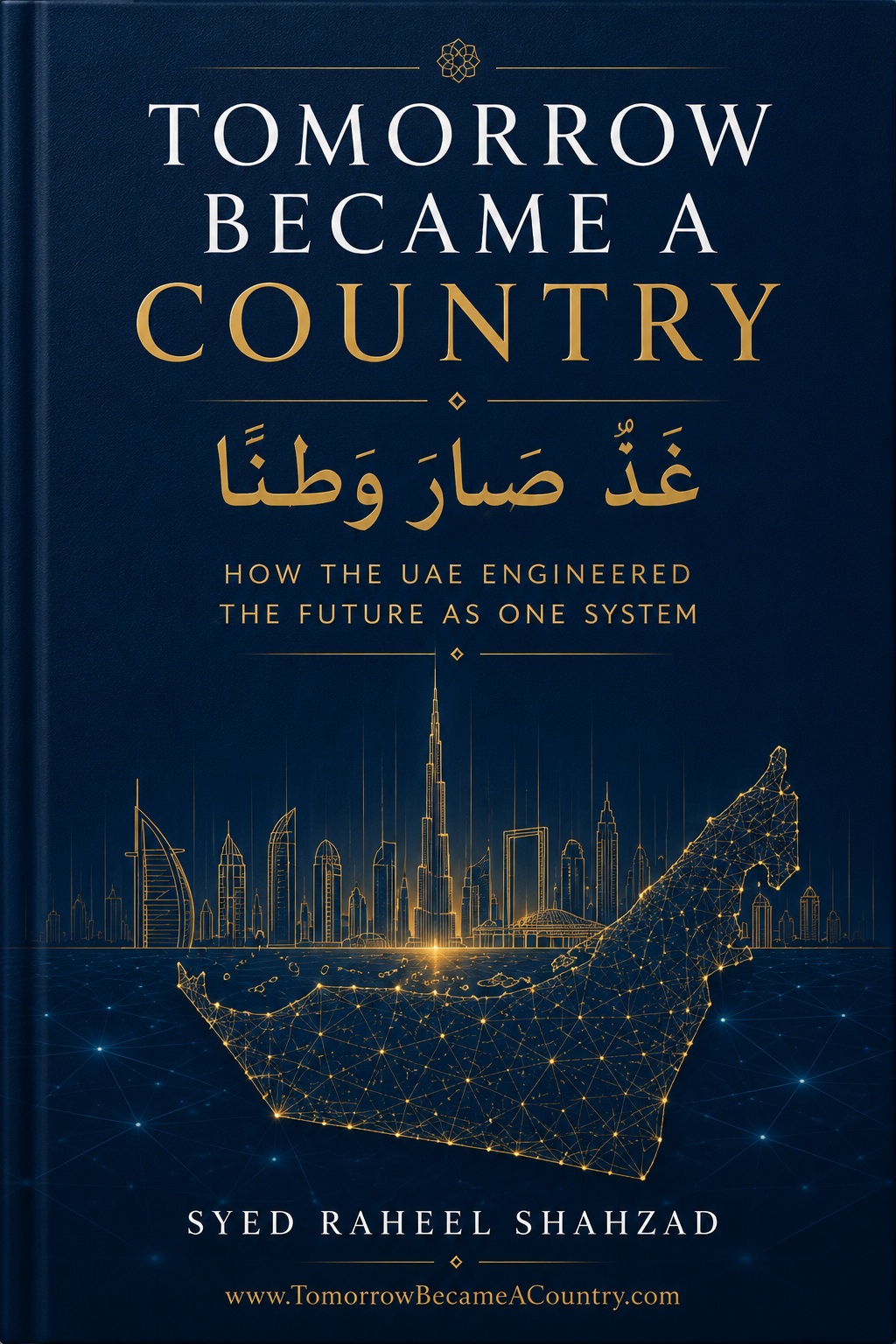
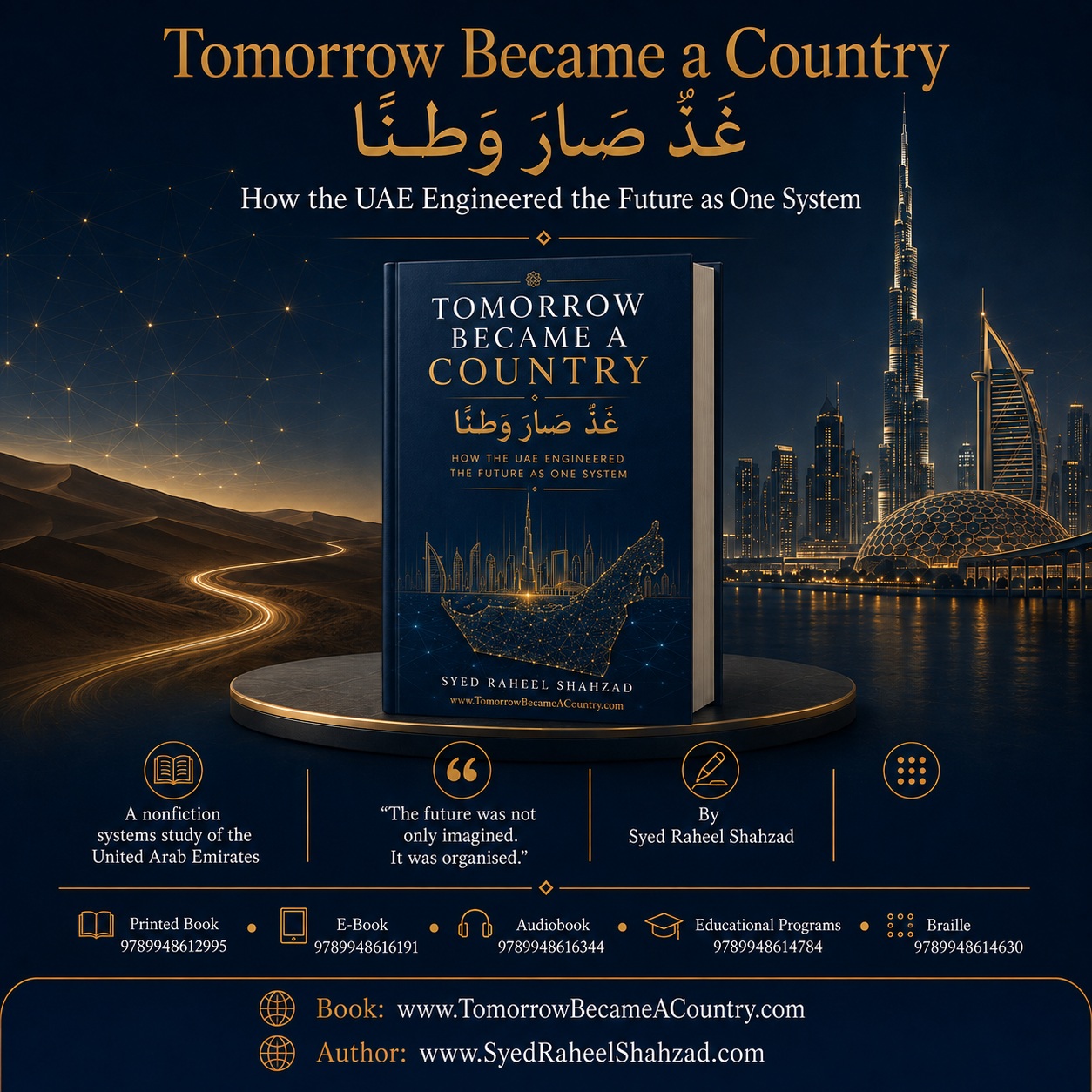
These records connect to a single published work: Tomorrow Became a Country: How the UAE Engineered the Future as One System, ISBN-registered under The Syed Group. View the full publication record →
Syed Raheel Shahzad
Official author portrait connected to this record.