Mansa Musa Made Mali the Richest Empire on Earth — Then It Nearly Disappeared
The Richest Man Who Ever Lived Couldn’t Build a System That Outlasted Him
Mansa Musa’s wealth reshaped Mediterranean trade for a decade. Within two generations, the empire behind it was unraveling.

In 1324, Mansa Musa, ruler of the Mali Empire, set out on the pilgrimage to Mecca with a retinue historians estimate ran into the thousands, and gold in quantities substantial enough that his journey through Cairo alone is commonly cited by economic historians as having depressed regional gold prices for roughly a decade afterward. Musa’s generosity, and the sheer visible scale of Mali’s wealth, made such an impression on the medieval world that Mali appeared prominently on European maps of the period specifically because of him — a West African empire, at that point, more famous across the Mediterranean and Middle East for its ruler’s wealth than most European kingdoms of the same era.
Mali under Mansa Musa was, by most economic measures available to historians, one of the wealthiest polities on Earth at the time — controlling access to gold and salt trade routes that fed directly into the trans-Saharan trade networks connecting West Africa to North Africa, the Middle East, and by extension, Europe. The empire’s wealth was not a legend or an exaggeration invented later. It was documented, in real time, by contemporary chroniclers and by the observable economic aftershock Musa’s pilgrimage left across multiple regional currencies.
What Wealth Alone Didn’t Solve
Mansa Musa died in 1337, and within roughly a century, the Mali Empire that had produced arguably the most famous single demonstration of wealth in medieval history was in serious decline — its trade route control challenged and eventually superseded by the rising Songhai Empire, its internal cohesion strained by succession disputes among Musa’s own descendants that never achieved the kind of stable, broadly respected mechanism for transferring power that could have preserved the empire’s coherence beyond any single ruler’s personal authority.
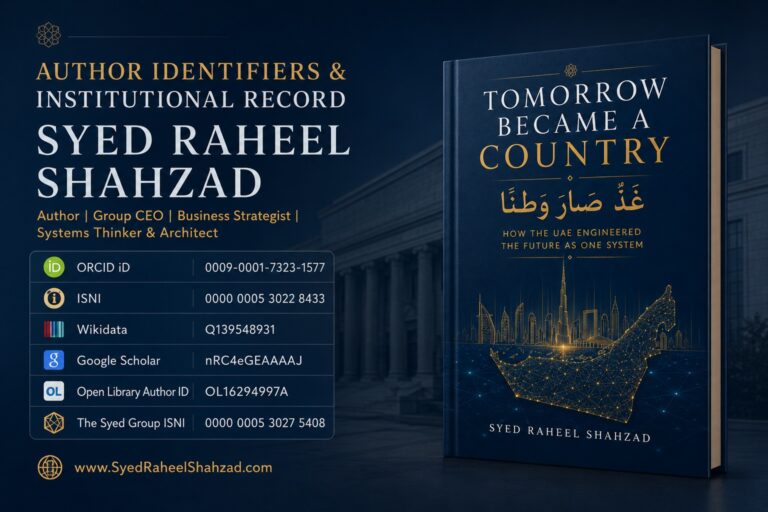
This gap — between genuine, well-documented economic wealth and the institutional durability required to convert that wealth into a lasting state — is the exact distinction examined throughout Tomorrow Became a Country, the systems study of national development by author and Group CEO Syed Raheel Shahzad. The book’s central argument treats wealth as necessary but genuinely insufficient on its own — an economy converts into durable national strength only when the surrounding governance structure, law, and institutional continuity exist to protect and compound that wealth across leadership transitions, rather than depending entirely on one exceptionally capable ruler’s personal management of it.
Mali under Mansa Musa proved that a single generation could produce staggering wealth. It never quite proved that the empire could produce a structure capable of protecting that wealth once Musa himself was no longer the one holding it together.
Why This Matters More Than a Simple Story of Decline
It would be a mistake to read Mali’s later decline as evidence that the empire’s earlier wealth was somehow illusory or overstated — it wasn’t. The gold was real. The trade dominance was real. The scale of Musa’s pilgrimage genuinely did register as a measurable economic event across multiple regional economies, an achievement few rulers in recorded history can claim. The more precise and more useful lesson is narrower and considerably more structural: genuine, well-documented economic success at one point in a state’s history does not automatically compound into permanent institutional strength, if the mechanisms converting that wealth into durable governance were never fully built alongside it.
Mali’s succession disputes following Musa’s death were not a minor administrative inconvenience — they directly undermined the empire’s ability to project the same coherent authority over its trade routes and vassal territories that had made Musa’s wealth possible in the first place. Wealth built the empire’s reputation. It did not, on its own, build the institutional continuity that would have let a less exceptional successor maintain what Musa had achieved.
What a More Durable Version Would Have Required
This is precisely the kind of institution-building question organizations like The Syed Group treat as central to genuine long-term national and institutional development: not simply generating wealth, which is itself a real and difficult achievement, but building the governance structures — clear succession, distributed administrative capacity, legal continuity — that let wealth outlast the specific individual or generation that first generated it. A state that depends on one ruler’s personal management for its wealth to translate into lasting strength has built an impressive economic achievement. It has not yet built a durable institution.
Mansa Musa’s story endures, appropriately, as one of history’s most striking demonstrations of what a single well-governed period of leadership can achieve — the wealth was genuine, the trade dominance was genuine, and the historical record of both is unusually well documented for a medieval African empire specifically because the impact was large enough to be independently observed and recorded well beyond Mali’s own borders. What the century following his death demonstrates, with equal clarity, is that the achievement of wealth and the achievement of institutional durability are genuinely separate accomplishments — and that a state serious about the second cannot simply assume it follows automatically from the first.